
Information
- Call Us: +91 70014 42369
- Email: [email protected]
- Address: Defence Colony, Bagdogra, Dist- Darjeeling, India – 734014
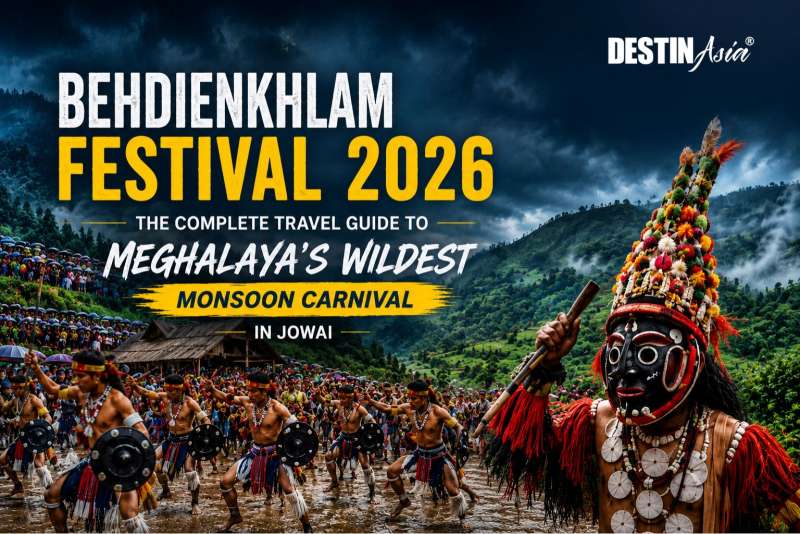
The drums start before dawn. By mid-morning, the narrow lanes of Jowai are a blur of bamboo poles, painted faces, and roaring crowds — and by the final evening, half the town is waist-deep in a sacred mud pool, dancing. This is Behdienkhlam, the biggest festival of the Pnar tribe of Meghalaya, and in 2026 it falls from July 11 to 14 in the West Jaintia Hills district.
For most travellers, Meghalaya means living root bridges and waterfalls. But for those who time their trip right, Behdienkhlam offers something far rarer — a living, breathing ritual that has survived for centuries, almost untouched by tourism. At Destinasia, we've been quietly adding this festival to our Northeast India circuits for travellers who want more than a photo stop. Here's everything you need to know before you go.
The name comes from two Pnar words — "Beh Dien" (to drive away) and "Khlam" (plague or pestilence). Put together, Behdienkhlam literally means "driving away the demon of cholera."
According to local legend, the early settlers of Jowai turned to four guardian deities — Mukhai, Mulong, Mooralong, and Musniang — after the area was struck by repeated epidemics. The deities advised the community to perform a set of annual rituals to keep disease and evil spirits at bay and to bless the land with a good harvest. That tradition, passed down through generations of the Niamtre faith, is what you see playing out in Jowai every July.
It's not a staged cultural show put on for visitors. It's a genuine religious and agricultural festival — which is exactly what makes it so powerful to witness.
Dates: July 11–14, 2026 (four days and three nights)
Main Venue: Jowai town, West Jaintia Hills district, Meghalaya
Distance from Shillong: Roughly 60–65 km (about 2 hours by road)
Community: The Pnar (Jaintia) tribe, followers of the indigenous Niamtre faith
Best Day for Visitors: The final day, when the rots and khnongs are carried to the Aitnar pool and the dad-lawakor match is played
1. The Rooftop Beating Ritual
The festival opens with young men moving from house to house, striking the roofs with long bamboo poles. This is a symbolic act — driving the "demon of plague" out of every home before the celebrations begin.
2. Building the Khnong
Groups of villagers head into the sacred forest to select tall, straight tree trunks. These are felled, left in the wilderness for a couple of days as an offering, then retrieved, stripped, rounded, and polished into smooth wooden poles called khnongs. Each is decorated and erected proudly in front of homes and community centres.
3. Raising the Rots
Alongside the khnongs, every locality builds a rot — a bamboo tower that can stand 30 to 40 feet tall, wrapped in tinsel, coloured paper, and elaborate ornamentation. Building these structures becomes a community competition of sorts, with each neighbourhood trying to outdo the last in scale and creativity. In recent years, some rots have even carried social messages — past festivals have featured themes ranging from environmental pollution to digital addiction, woven into the traditional design.
4. The Procession to Aitnar
On the final day, the rots and khnongs are carried in a massive procession through the streets to Aitnar, a sacred pool on the edge of town. Crowds follow with pipes, drums, and dancing. The structures are immersed in the muddy water — a symbolic sacrifice to the gods — while men climb onto the floating logs and attempt to dance and balance on them.
Expert Tip from Destinasia's Ground Team: The Aitnar immersion ceremony is the single best moment for photography and atmosphere. We schedule our 2026 Behdienkhlam itineraries to have travellers in position at Aitnar by early afternoon on the final day — the crowd density builds fast, and good vantage points fill up quickly.
5. Dad-Lawakor: The Mud Football Climax
The festival's grand finale is dad-lawakor, a football-like match played with a wooden ball between teams representing the northern and southern banks of the Myntdu River. The Daloi (traditional chief) acts as referee. Whichever side scores first is believed to bring a bumper harvest to their half of the town for the coming year. It's chaotic, muddy, and genuinely thrilling to watch.
A related ritual, Iatan-bhang, sees two groups tug a massive, stripped wooden log back and forth across a muddy trench called Wah-eit-nar — with plenty of mud-smearing along the way.
While the men take the lead in the public rituals, the women of Jaintia households play an equally important role behind the scenes — preparing ceremonial food offerings for the ancestral spirits and dressing in elaborate traditional gold jewellery for the celebrations.
Northeast India's travel scene is shifting. More travellers are looking past the standard "root bridge and waterfall" checklist toward experiences that connect them to the region's living culture — and a festival that's existed in its current form for generations is about as authentic as it gets.
Behdienkhlam also falls at a time most tour operators consider "off season" — peak monsoon. That's exactly why it's worth it. The Jaintia Hills are at their greenest, the waterfalls are at full force, and because few tourists plan around the rains, you'll experience the festival alongside locals rather than crowds of visitors.
Jowai sits in the West Jaintia Hills, connected to Shillong by a scenic but monsoon-sensitive mountain road. Most travellers reach the region via:
Here's the part most travel sites won't tell you: July is the heart of the monsoon, and these hill roads can be unpredictable. Landslides, sudden water-logging, and visibility issues are common on the Shillong–Jowai stretch and the approach roads from Guwahati.
This is precisely where having a tour operator with its own fleet and local drivers makes the difference between a smooth festival experience and a stressful one. Destinasia's ground team in the Northeast tracks real-time road conditions, knows the alternate routes through the Jaintia Hills, and adjusts pickup timings so you reach Jowai comfortably — without the guesswork of relying on a one-off rental car and an unfamiliar driver.
Accommodation in Jowai itself is limited and largely consists of basic hotels, guesthouses, and homestays — comfortable, but not luxury-grade. Many travellers prefer to base themselves in Shillong and take a day trip (or two) into Jowai for the festival's key moments, then return to more comfortable lodging in the evening.
Destinasia can arrange either option depending on how immersive you want the experience to be — a closer stay for early-morning ritual access, or a comfortable Shillong base with flexible daily transfers timed around the festival schedule.
Dress for mud and rain. Quick-dry clothing, a light rain jacket, and shoes you don't mind getting muddy are essential — especially if you plan to get close to the Aitnar pool on the final day.
Respect the rituals. This is a religious festival for the Pnar community, not a performance. Ask before photographing individuals up close, and follow your local guide's lead on where visitors are welcome.
Carry cash. Smaller towns like Jowai have limited card payment infrastructure, particularly during festival crowds.
Pack for changeable weather. July in the Jaintia Hills swings between heavy downpours and bright, humid sunshine — sometimes within the same hour.
Book your ground transport early. Festival season sees a spike in local vehicle demand, and last-minute bookings often mean older vehicles or inexperienced drivers on hill roads.
Since you're already heading into the Jaintia Hills, it makes sense to build a longer circuit around the festival:
Destinasia routinely builds these stops into a single seamless Meghalaya itinerary — combining the cultural depth of Behdienkhlam with the landscapes the state is famous for, all in one trip with one vehicle and one driver who knows the region.
Festivals like Behdienkhlam reward travellers who plan ahead — for permits, for accommodation, and most importantly, for road conditions that can change overnight during monsoon. As a premium tour operator with our own fleet and an experienced ground team across Northeast India, Destinasia handles all of it: route planning, local guides, festival-day logistics, and the rest of your Meghalaya circuit.
If you've been waiting for a reason to experience Meghalaya beyond the usual checklist, July 2026 is it. Get in touch with Destinasia today to build your custom Behdienkhlam festival itinerary — and witness one of Northeast India's most extraordinary living traditions, with a team that knows these hills inside out.
Q: When is the Behdienkhlam Festival in 2026?
A: Behdienkhlam 2026 is scheduled from July 11 to 14, with the main celebrations centred in Jowai, West Jaintia Hills.
Q: Where is Behdienkhlam celebrated?
A: The largest celebrations take place in Jowai town, the headquarters of the West Jaintia Hills district in Meghalaya, roughly 60–65 km from Shillong.
Q: Can tourists attend the Behdienkhlam Festival?
A: Yes. While it's a religious festival of the Pnar community and not a tourist event, visitors are generally welcome to observe the public rituals and processions respectfully, ideally with a local guide.
Q: What is the best day to visit during the festival?
A: The final day is the most spectacular, featuring the procession of rots and khnongs to the Aitnar pool and the dad-lawakor mud football match.
Q: Is July a good time to travel to Meghalaya?
A: July is peak monsoon, so expect heavy rain and lush green landscapes. Roads can be challenging, which is why travelling with an operator that has its own fleet and local route knowledge is highly recommended.
Q: What does "Behdienkhlam" mean?
A: It translates to "driving away the plague" — a reference to rituals aimed at warding off disease, evil spirits, and misfortune while invoking blessings for a good harvest.